Back

Pingfinn

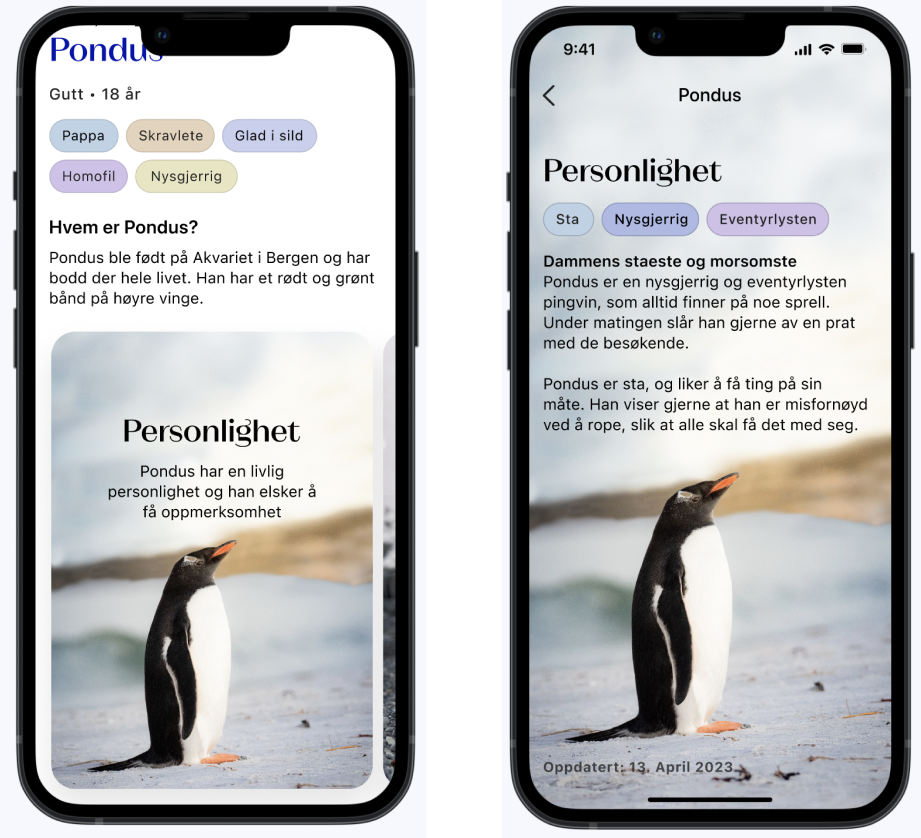
The penguin pool is home to nearly thirty gentoo penguins. You will notice that each penguin is marked with a color-coded band, but what does this mean? Initially, the band is simply a way to distinguish the penguins from one another, but now it may serve yet another purpose. It could offer you the chance to get to know each individual penguin even better. After all, size and the color of the band are not the only things that set the penguins apart. They are so much more than that. They are entirely unique and, in many respects, just like us humans. They have strong personalities, friendships and romantic relationships, intrigues, diverse sexualities, and, most importantly, no two are alike.

Role

Reseacher, facilitator in Design Sprint

Time

Spring 2023 (Student project at University of Bergen)

Target audience

Pingfinn is specifically designed to reach families with children aged 10–14. Families with children in this age group have diverse interests and preferences; consequently, significant effort has gone into understanding what will truly engage them. We have also invested resources in understanding how families perceive and receive information.

Purpose

The purpose of Pingfinn is to create an engaging, inspiring, and educational experience for visitors to the Aquarium, with a focus on families as the target audience. Through personalization, learning, gamification, and exclusive content, we aim to spark curiosity about the penguins, their personalities, and their behavior. The Ministry of Agriculture and Food states that knowledge of species-specific behavior and familiarity with an animal makes it easier to relate to its situation (Report No. 12 to the Storting (2002–2003), p. 17). With this in mind, we formulated a hypothesis that Pingfinn would provide value by fostering a personal connection to the animals, which in turn would increase empathy and the desire to conserve marine wildlife.

Insight

As part of the process of developing Pingfinn, we placed great emphasis on in-depth interviews and observation as qualitative methods for gathering insights. We conducted in-depth interviews to collect data on what matters to users regarding design and content. These conversations involved the target audience, biology students, and various content communicators at museums that cater primarily to children.

​

We observed visitors at institutions that use technology to convey content and spoke with staff members about the impact this technology has on the visitor experience. Through this process, we sought to understand who uses the technology, how they use it, and the reasons behind specific user actions.
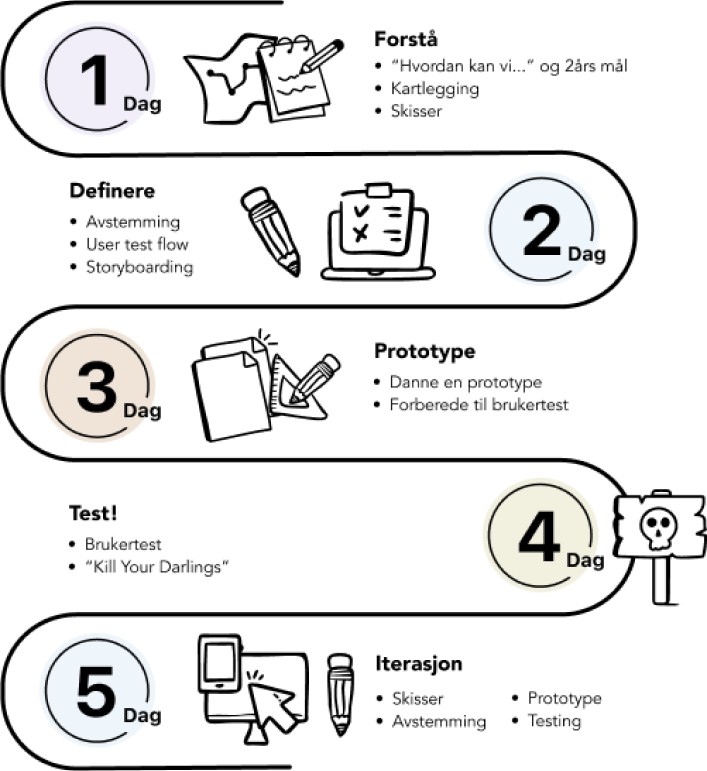
Overall, our insight-gathering and user testing have been crucial in developing a feature that both resonates with our target audience and delivers value to the Aquarium. Pingfinn emerged from a design sprint, a process in which we streamlined and structured our ideation. A design sprint is a method for solving major problems and testing new concepts; it is described as a shortcut to learning that avoids the need to build and launch a full service.

Contact me on Linkedin

Hedvig Bache Hungnes © 2026 All Rights Reserved

Back

Pingfinn

The penguin pool is home to nearly thirty gentoo penguins. You will notice that each penguin is marked with a color-coded band, but what does this mean? Initially, the band is simply a way to distinguish the penguins from one another, but now it may serve yet another purpose. It could offer you the chance to get to know each individual penguin even better. After all, size and the color of the band are not the only things that set the penguins apart. They are so much more than that. They are entirely unique and, in many respects, just like us humans. They have strong personalities, friendships and romantic relationships, intrigues, diverse sexualities, and, most importantly, no two are alike.

Role

Reseacher, facilitator in Design Sprint

Time

Spring 2023 (Student project at University of Bergen)

Target audience

Pingfinn is specifically designed to reach families with children aged 10–14. Families with children in this age group have diverse interests and preferences; consequently, significant effort has gone into understanding what will truly engage them. We have also invested resources in understanding how families perceive and receive information.

Purpose

The purpose of Pingfinn is to create an engaging, inspiring, and educational experience for visitors to the Aquarium, with a focus on families as the target audience. Through personalization, learning, gamification, and exclusive content, we aim to spark curiosity about the penguins, their personalities, and their behavior. The Ministry of Agriculture and Food states that knowledge of species-specific behavior and familiarity with an animal makes it easier to relate to its situation (Report No. 12 to the Storting (2002–2003), p. 17). With this in mind, we formulated a hypothesis that Pingfinn would provide value by fostering a personal connection to the animals, which in turn would increase empathy and the desire to conserve marine wildlife.

Insight

As part of the process of developing Pingfinn, we placed great emphasis on in-depth interviews and observation as qualitative methods for gathering insights. We conducted in-depth interviews to collect data on what matters to users regarding design and content. These conversations involved the target audience, biology students, and various content communicators at museums that cater primarily to children.

​

We observed visitors at institutions that use technology to convey content and spoke with staff members about the impact this technology has on the visitor experience. Through this process, we sought to understand who uses the technology, how they use it, and the reasons behind specific user actions.

Overall, our insight-gathering and user testing have been crucial in developing a feature that both resonates with our target audience and delivers value to the Aquarium. Pingfinn emerged from a design sprint, a process in which we streamlined and structured our ideation. A design sprint is a method for solving major problems and testing new concepts; it is described as a shortcut to learning that avoids the need to build and launch a full service.

Contact me on Linkedin

Hedvig Bache Hungnes © 2026 All Rights Reserved

Back

Pingfinn

The penguin pool is home to nearly thirty gentoo penguins. You will notice that each penguin is marked with a color-coded band, but what does this mean? Initially, the band is simply a way to distinguish the penguins from one another, but now it may serve yet another purpose. It could offer you the chance to get to know each individual penguin even better. After all, size and the color of the band are not the only things that set the penguins apart. They are so much more than that. They are entirely unique and, in many respects, just like us humans. They have strong personalities, friendships and romantic relationships, intrigues, diverse sexualities, and, most importantly, no two are alike.

Role

Reseacher, facilitator in Design Sprint

Time

Spring 2023 (Student project at University of Bergen)

Target audience

Pingfinn is specifically designed to reach families with children aged 10–14. Families with children in this age group have diverse interests and preferences; consequently, significant effort has gone into understanding what will truly engage them. We have also invested resources in understanding how families perceive and receive information.

Purpose

The purpose of Pingfinn is to create an engaging, inspiring, and educational experience for visitors to the Aquarium, with a focus on families as the target audience. Through personalization, learning, gamification, and exclusive content, we aim to spark curiosity about the penguins, their personalities, and their behavior. The Ministry of Agriculture and Food states that knowledge of species-specific behavior and familiarity with an animal makes it easier to relate to its situation (Report No. 12 to the Storting (2002–2003), p. 17). With this in mind, we formulated a hypothesis that Pingfinn would provide value by fostering a personal connection to the animals, which in turn would increase empathy and the desire to conserve marine wildlife.

Insight

As part of the process of developing Pingfinn, we placed great emphasis on in-depth interviews and observation as qualitative methods for gathering insights. We conducted in-depth interviews to collect data on what matters to users regarding design and content. These conversations involved the target audience, biology students, and various content communicators at museums that cater primarily to children.

​

We observed visitors at institutions that use technology to convey content and spoke with staff members about the impact this technology has on the visitor experience. Through this process, we sought to understand who uses the technology, how they use it, and the reasons behind specific user actions.

Overall, our insight-gathering and user testing have been crucial in developing a feature that both resonates with our target audience and delivers value to the Aquarium. Pingfinn emerged from a design sprint, a process in which we streamlined and structured our ideation. A design sprint is a method for solving major problems and testing new concepts; it is described as a shortcut to learning that avoids the need to build and launch a full service.

Contact me on Linkedin

Hedvig Bache Hungnes © 2026 All Rights Reserved